
Document library
Khata
A Khata is the municipal record that says a property exists, who is assessed for tax on it, and what its measurements and usage are. It is a tax and identity record, not a title document.
Checked: August 2026
What the whole document looks like
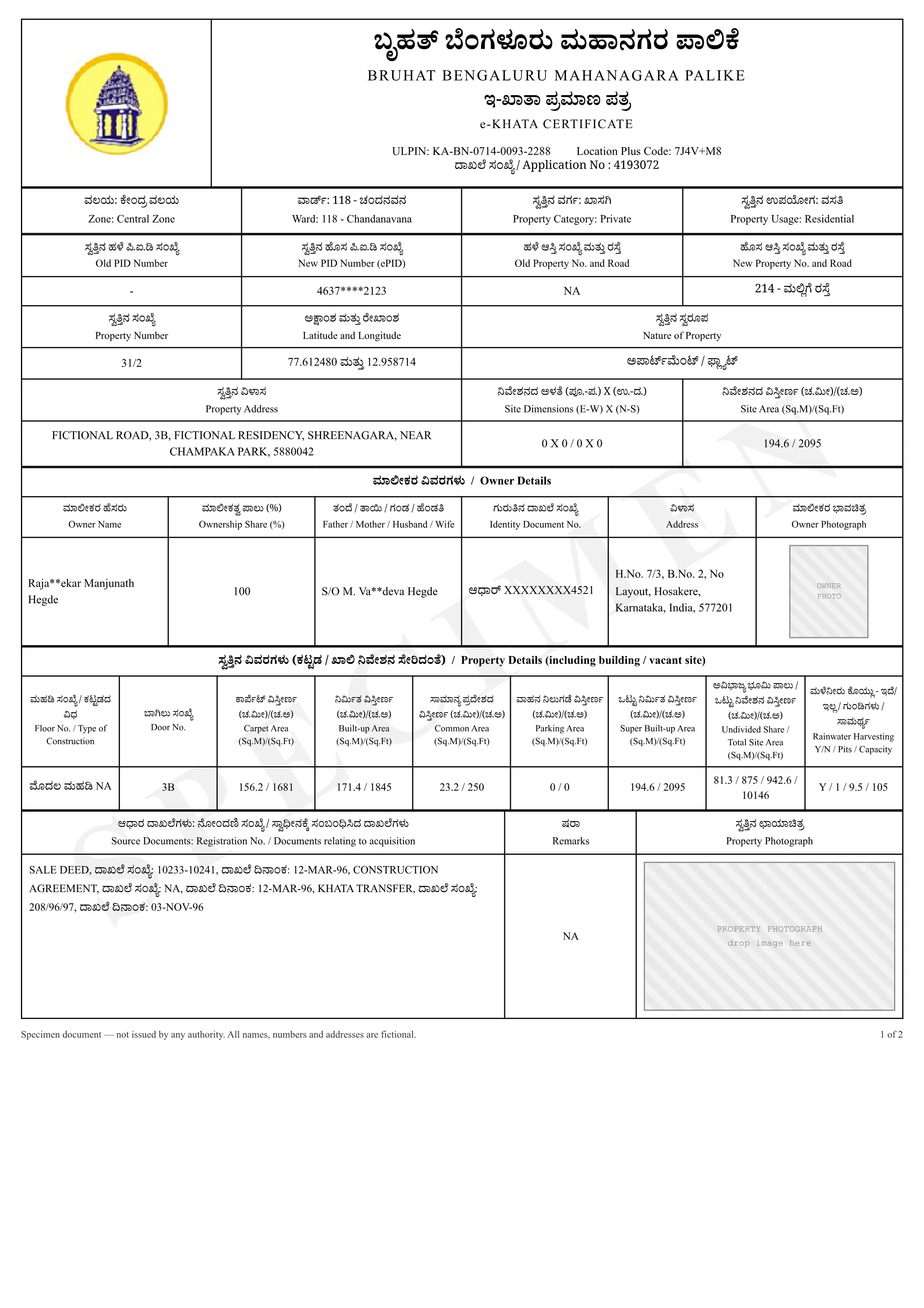
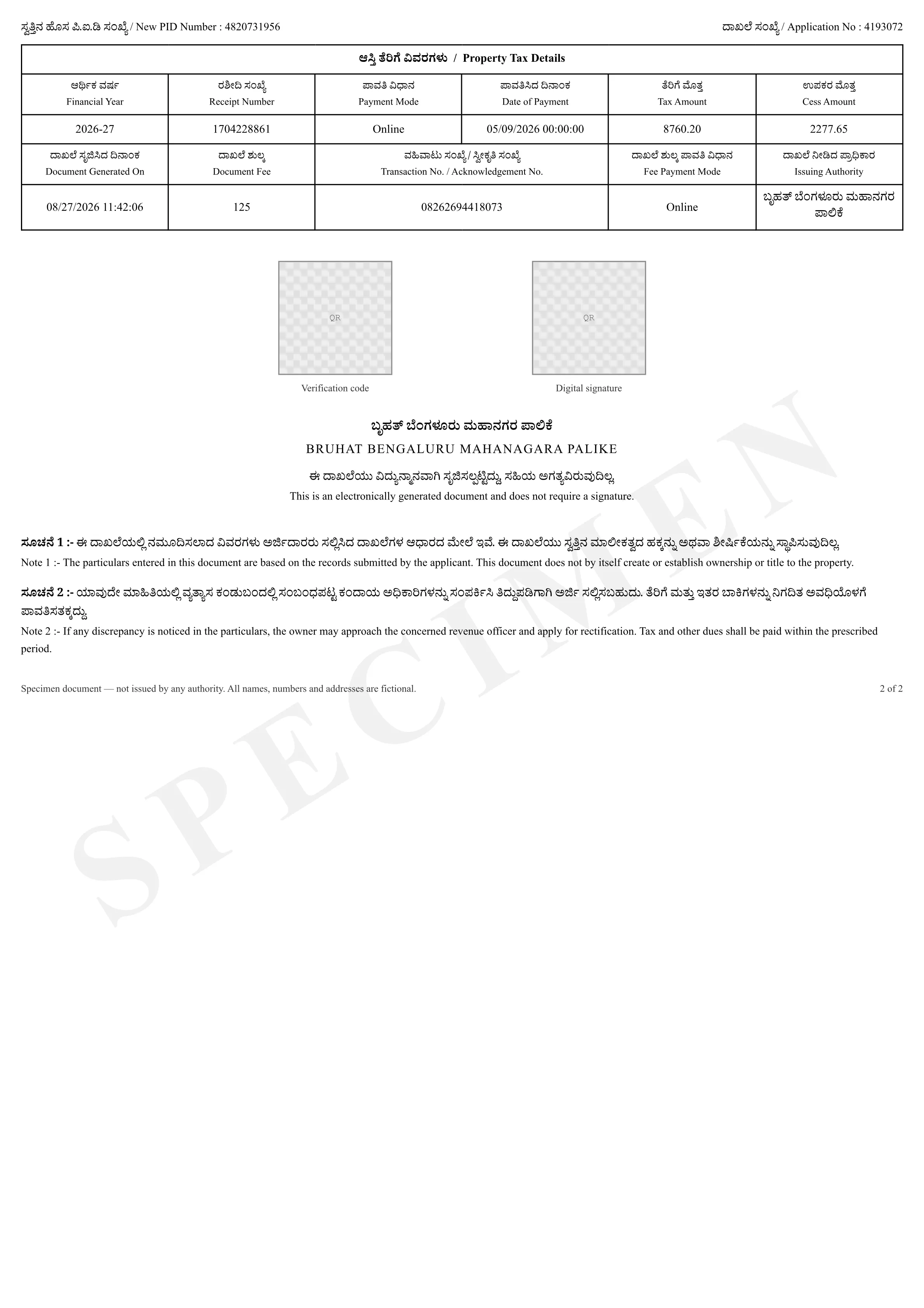
Both pages of the specimen e-Khata certificate, fitted to the column. These are for shape and layout, not for reading. Open one to see it full size, or read the annotated walkthrough below.
What it is
It does not prove you own the property. The sale deed does that. That distinction is the single most common misunderstanding in Bengaluru property, and it is where this page earns its place.
The certificate, annotated
A specimen e-Khata certificate, cut into the parts worth understanding. Every crop is from the same fictional document, watermarked and issued by nobody.
The identifiers at the top

Scroll sideways to see the full width. Specimen document. Every name, number and measurement on it is fictional.
The ULPIN is the unique identifier for the property itself. It stays with the property rather than with you, so it is the number worth quoting when you ask anyone a question about it.
Zone, ward, category and usage

Scroll sideways to see the full width. Specimen document. Every name, number and measurement on it is fictional.
Usage is the field to read carefully. A property recorded as residential and used as something else is a problem you inherit on purchase, not one you can settle afterwards.
Owner details, and what they are not
Scroll sideways to see the full width. Specimen document. Every name, number and measurement on it is fictional.
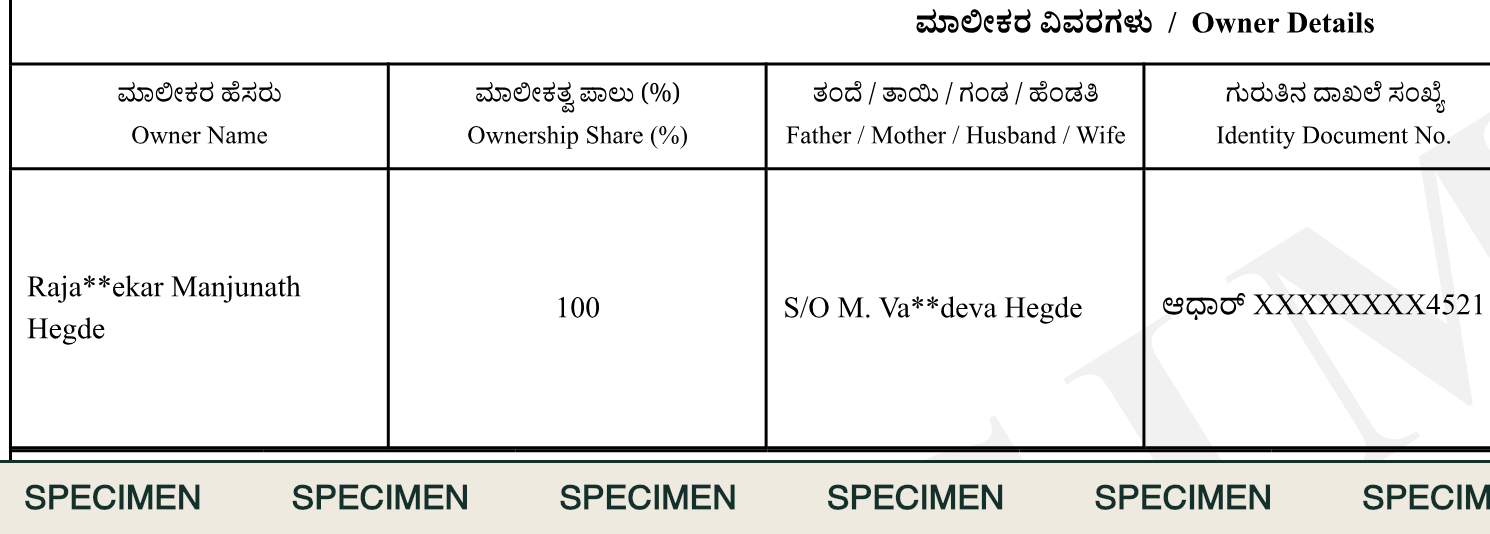
A name here means this person is assessed for tax on the property. It does not mean they own it. Ownership share matters when a property is held jointly, because every holder has to sign.
The identity number is masked on the certificate, which is the format the portal issues.
The five area types, on one page
Scroll sideways to see the full width. Specimen document. Every name, number and measurement on it is fictional.
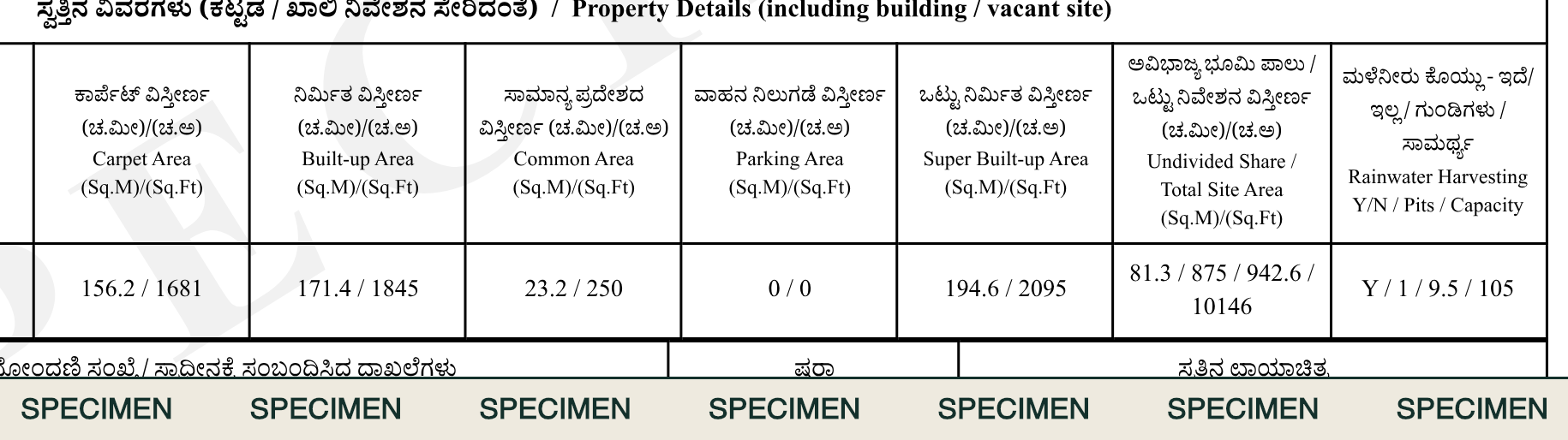
This is the most useful thing on the certificate. Carpet 1,681 sq ft. Built-up 1,845. Common 250. Super built-up 2,095. Undivided share 875.
A buyer paying for 2,095 sq ft is living in 1,681 sq ft. That is roughly 25 percent loading, visible in a single official document.
It is the clearest possible illustration of why price per square foot means nothing until you ask which square foot.
Source documents
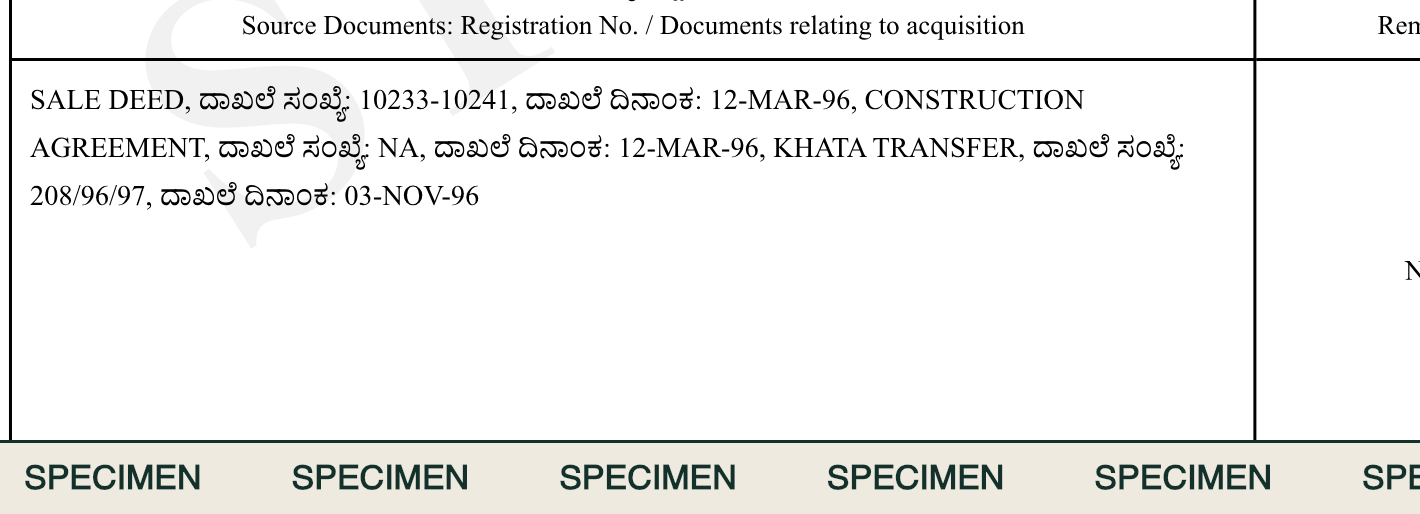
Scroll sideways to see the full width. Specimen document. Every name, number and measurement on it is fictional.
The registration numbers and dates of the documents the record was built from. Check these against the deeds you are actually shown. A mismatch here is the kind of thing that is cheap to ask about now and expensive to discover later.
Note 1, which settles the argument

Scroll sideways to see the full width. Specimen document. Every name, number and measurement on it is fictional.
Printed on the certificate itself:
"The particulars entered in this document are based on the records submitted by the applicant. This document does not by itself create or establish ownership or title to the property."
That is the government form saying, in its own words, what a Khata is not. If anyone tells you a Khata proves ownership, this line is on the document they are showing you.
What it proves, and what it does not
It proves the municipality has a record of the property and knows who to bill. It does not prove ownership, it does not prove the construction is legal, and it does not prove the measurements are right.
A-Khata marks a property that is compliant: built on converted land with an approved plan, within the by-laws, with charges paid. It can get a building plan sanction, a loan from any bank, and it resells cleanly.
B-Khata is a separate register for properties that are irregular in some way. Unauthorised construction, layout or setback deviations, or unpaid betterment charges. You can pay property tax on a B-Khata, and that is roughly where the advantages end.
- Financing is harder, but not impossible. This is where most articles overstate it. Several banks and NBFCs will lend against a B-Khata property, particularly in the current competitive market. Expect a higher interest rate, a lower loan to value, and additional conditions. What you will not get is the pick of every lender at the best rate.
- You cannot get a building plan sanctioned
- Your buyer pool at resale is smaller, because your buyer faces the same financing question you did
- It usually sells at a discount to a comparable A-Khata property
The discount, in our experience: roughly 15 to 25 percent below a comparable A-Khata property in the same micro market. Treat that as approximate. It moves with the specific property and the specific situation, and we have seen it fall outside that range in both directions.
e-Khata
Introduced October 2024. The digital version of the same record, via the e-Aasthi system.
A verified e-Khata has been mandatory for property registration since 1 July 2025. Kaveri 2.0 will not process a sale deed registration without one. If the e-Khata field is empty or unverified, the portal blocks it.
Digitising a B-Khata does not upgrade it. An e-Khata generated on a B-Khata property is still a B-Khata. People assume the new digital record resets their status, and it does not.
If your e-Khata says BBMP, it is still valid
BBMP was dissolved in September 2025 and replaced by the Greater Bengaluru Authority, which sits above five city corporations. Certificates issued before that change carry the BBMP header. Certificates issued since carry the name of whichever corporation your property falls under.
Both are valid. You do not need to have an older document reissued, and anyone telling you otherwise is either mistaken or selling you a service you do not need.
Two practical points beyond that. Khata services now go to whichever of the five city corporations has jurisdiction: Bengaluru North, South, East, West or Central, and the old 198 wards became 369. And file migration between the old and new systems is causing delays to Khata transfers and approvals, so factor it into timelines rather than being surprised by it.
B to A conversion, current position
The fee is 5 percent of guidance value. A concession cutting it to 2 percent ran from 15 May 2026 to 23 August 2026 under the Bhu Guarantee drive and expired on 24 August 2026.
Most articles online still quote 2 percent. They are out of date.
Eligibility, broadly: property registered before 30 September 2024, no major violations, tax dues cleared, public road access, and a valid e-Khata. The Karnataka Municipal Corporations (Amendment) Bill 2026, passed 21 August 2026, extends A-Khata rights to eligible properties in unauthorised layouts.
These rules are new and still bedding in. The Bill passed in August 2026 and the implementation detail is still settling. Confirm the current position with a property lawyer for your specific property rather than relying on any published summary, including this one. We check it file by file for the same reason.
Khata transfer after a purchase
First, a distinction people get wrong constantly. A Khata extract is a document you download. A Khata transfer is a full application process that moves the record into your name after a purchase. They are not the same thing and they are not comparable in effort. Being handed an extract is not evidence that a transfer has happened.
Filed on the e-Aasthi portal. You need the registered sale deed, a current EC, the OC if it is an apartment, and property tax receipts.
All property tax dues must be cleared first. The system cross-checks against the tax database and rejects applications with arrears at verification.
Cost. The government fee is 2 percent of the registered stamp duty. Note carefully: 2 percent of the stamp duty that was paid, not 2 percent of the property value. Confusing the two is an expensive mistake. That figure is the government fee only. Small statutory charges apply on top, and any professional assistance is separate.
Timeline: 30 to 60 working days, in our experience. Files with tax arrears, a name mismatch or a missing OC take longer.
Why timelines slip, honestly
We would rather tell you this than quote a confident number we cannot hold to. Delays are genuinely unpredictable, and the common causes are:
- Staff diverted to other government duties. Election work and SIR duty pull officers off routine files for weeks at a time. Nothing about your application is wrong; the office is simply doing something else
- Technical issues on the portals
- Documentation that is incomplete or incorrect
- Spelling mismatches between government IDs and the sale deed. A name spelt one way on an Aadhaar and another on a deed will stop a file, and it is one of the most common causes we see
The last one is worth acting on before you buy rather than after. It is easy to fix in advance and slow to fix once a file is in the queue.
Red flags
- Seller offers a B-Khata property described as "A-Khata soon" with no application filed
- An e-Khata is produced as proof the property is now A-Khata
- Khata name does not match the sale deed seller
- Tax arrears the seller wants settled after registration
- Khata measurements do not match the actual site
Questions
- Is a Khata proof of ownership?
- No. A Khata is a tax and identity record. It says a property exists, who is assessed for tax on it, and what its measurements and usage are. The sale deed is what proves ownership. The certificate itself carries a note saying it does not by itself create or establish ownership or title.
- Can I get a home loan on a B-Khata property?
- Financing is harder, but not impossible. Several banks and NBFCs will lend against a B-Khata property, particularly in the current competitive market. Expect a higher interest rate, a lower loan to value, and additional conditions. What you will not get is the pick of every lender at the best rate.
- Does an e-Khata make my B-Khata an A-Khata?
- No. Digitising a B-Khata does not upgrade it. An e-Khata generated on a B-Khata property is still a B-Khata. People assume the new digital record resets their status, and it does not.
- What does B to A conversion cost now?
- The fee is 5 percent of guidance value. A concession cutting it to 2 percent ran from 15 May 2026 to 23 August 2026 under the Bhu Guarantee drive and expired on 24 August 2026. Most articles online still quote 2 percent and are out of date.
- Is my old BBMP Khata still valid?
- Yes. BBMP was dissolved on 2 September 2025 and replaced by the Greater Bengaluru Authority and five city corporations. Existing BBMP-issued Khata certificates remain valid and do not need reissuing. People are being told otherwise and it is not true.
- How long does a Khata transfer take?
- 30 to 60 working days in our experience. Files with tax arrears, a name mismatch or a missing occupancy certificate take longer. File migration between the old and new systems is currently causing additional delays.
- What does a Khata transfer cost?
- The government fee is 2 percent of the registered stamp duty. Note carefully: 2 percent of the stamp duty that was paid, not 2 percent of the property value. Confusing the two is an expensive mistake. Small statutory charges apply on top, and any professional assistance is separate.
- What happens if I do not transfer the Khata after buying?
- The municipal record continues to name the previous owner, which means they remain the person assessed for tax on a property you own. A Khata extract is a document you download. A Khata transfer is a full application process that moves the record into your name. Being handed an extract is not evidence that a transfer has happened.
Ask us about a specific Khata.
Send us the document and we will tell you what it says and what it does not.
General information, not advice. Compiled from public sources and professional input, and checked on the date shown at the top of this page. Indian property law, tax and municipal procedure change frequently. Confirm your own position with a Chartered Accountant, a lawyer or the relevant authority before you act. We are happy to introduce you to people we work with. Full disclaimer