
Document library
Encumbrance certificate
An EC is a list of every registered transaction against a property for a period you choose. Sales, mortgages, gifts, releases, partitions. It is obtained from Kaveri Online.
Checked: August 2026
What the whole document looks like
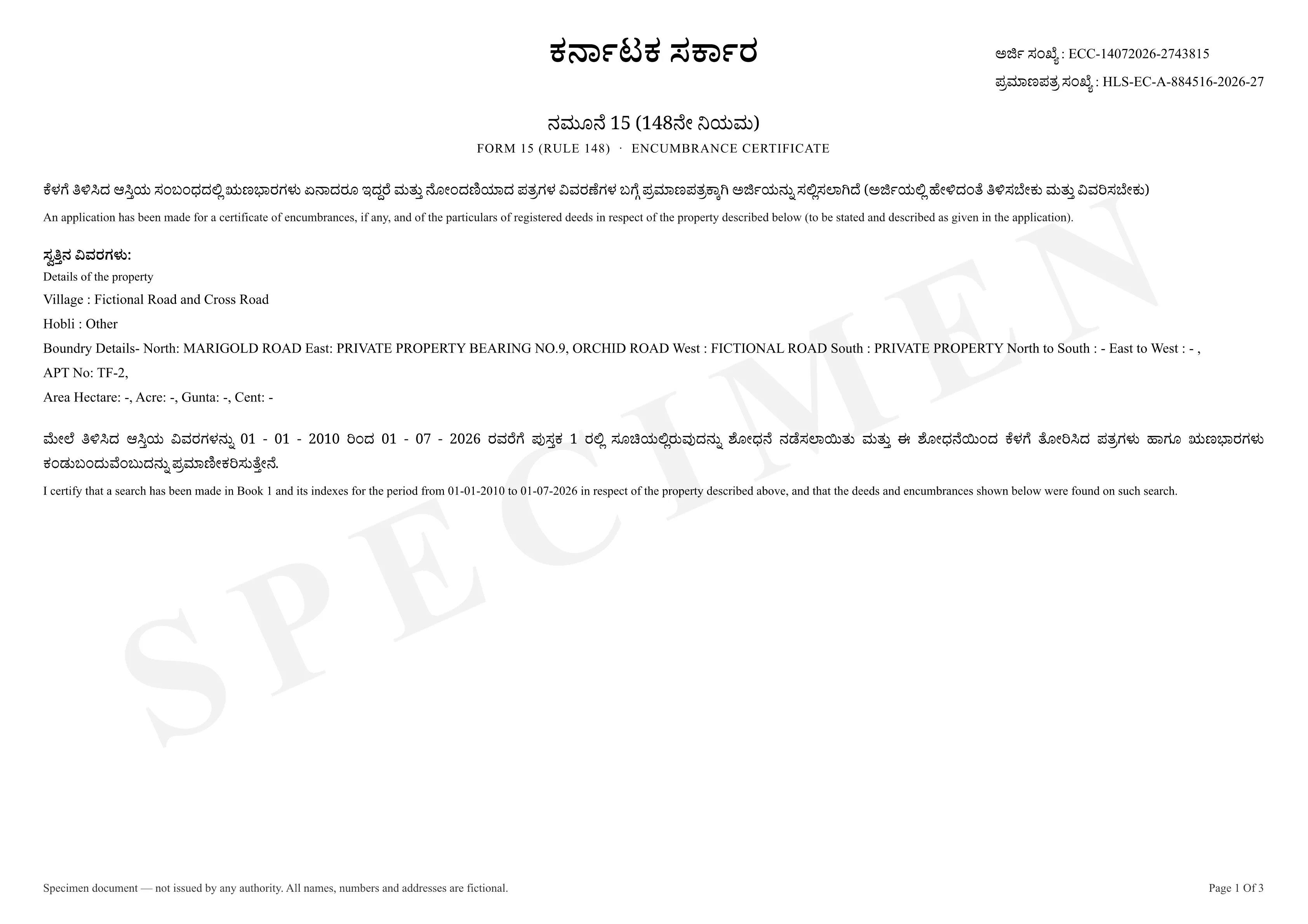
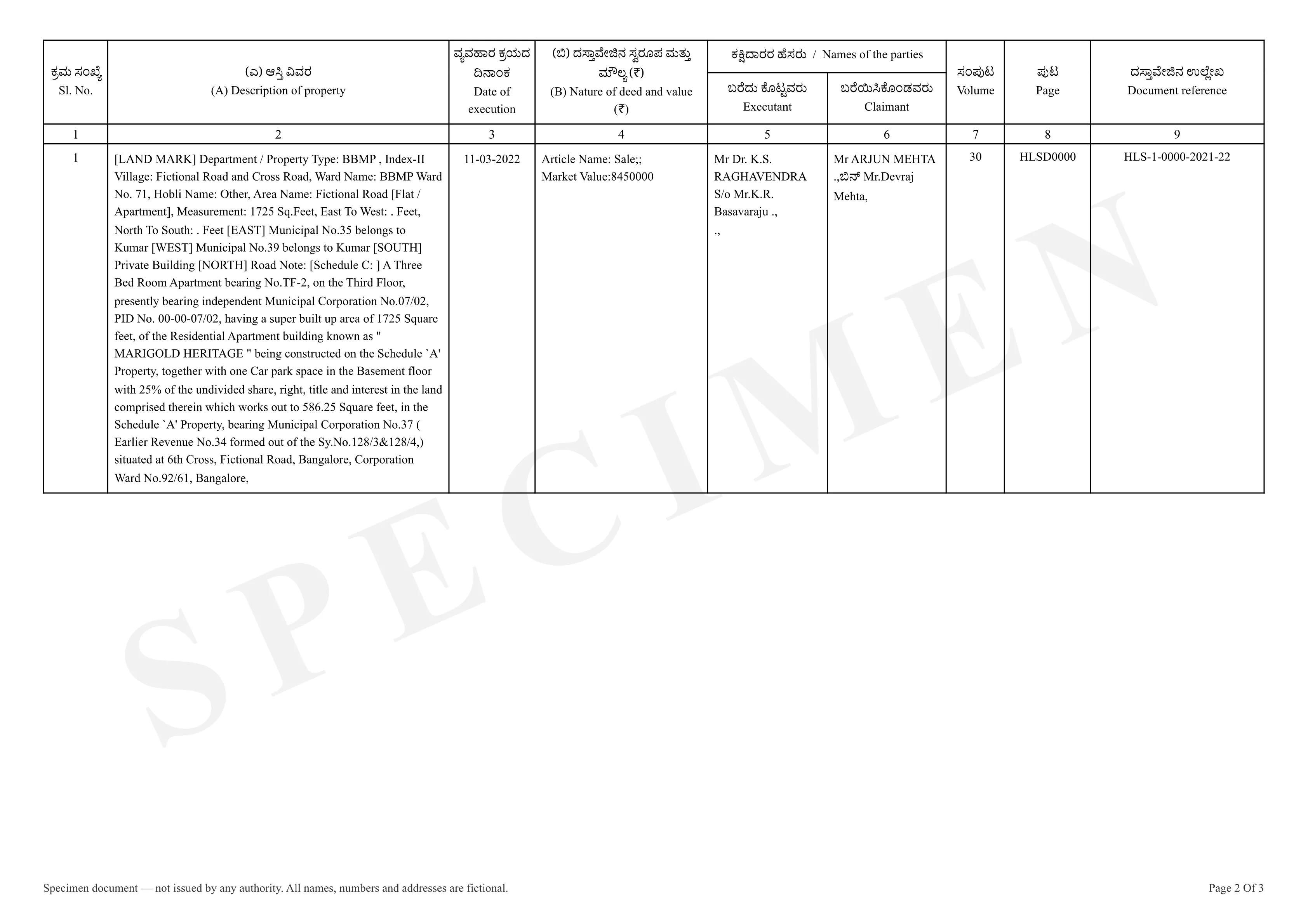
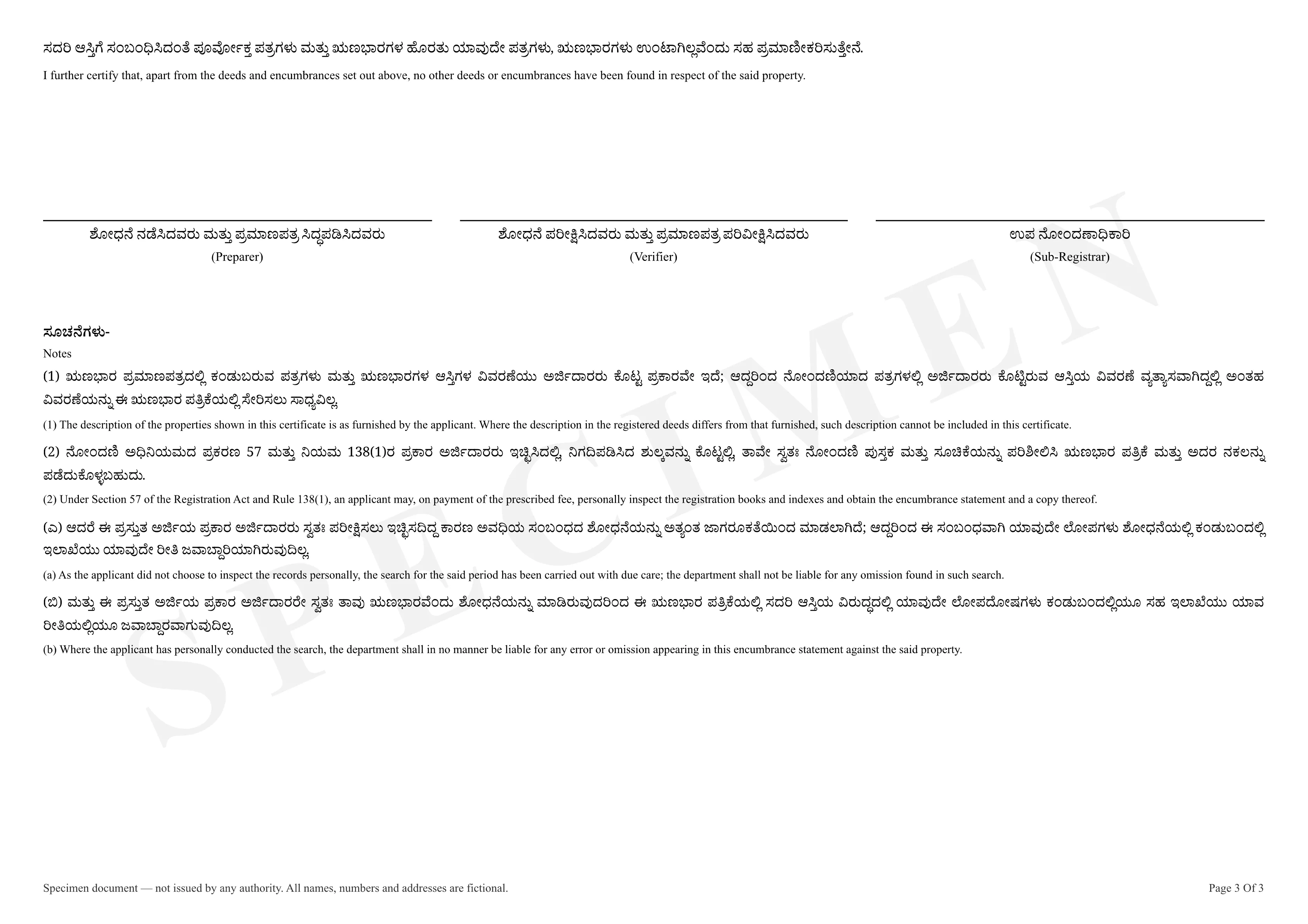
All three pages of the specimen Form 15, fitted to the column. These are for shape and layout, not for reading. Open one to see it full size, or read the annotated walkthrough below.
And a Form 16, the Nil EC
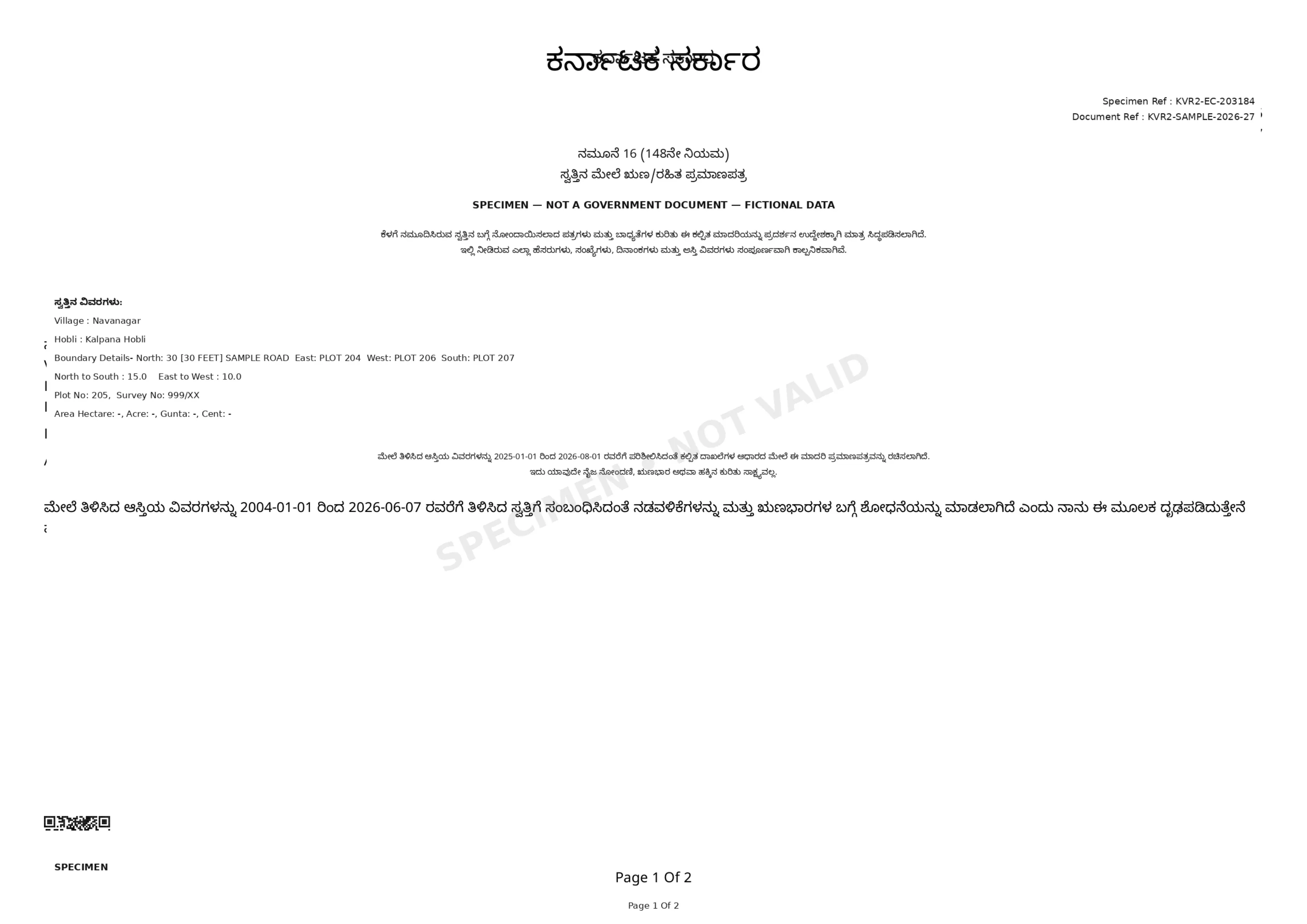
Both pages of the specimen Form 16, at the same scale as the Form 15 above. The comparison is the point: this is what a certificate looks like when nothing was found.
Form 15 and Form 16, and why the difference matters
Form 15 is issued when registered transactions exist in the search period. It lists them.
Form 16 is issued when none are found. Commonly called a "Nil EC".
Here is the part that matters, and where most buyers go wrong. A Form 16 is often presented as proof of clean title. It is not. It means no registered transactions were found in the period searched, and nothing more.
The certificate, annotated
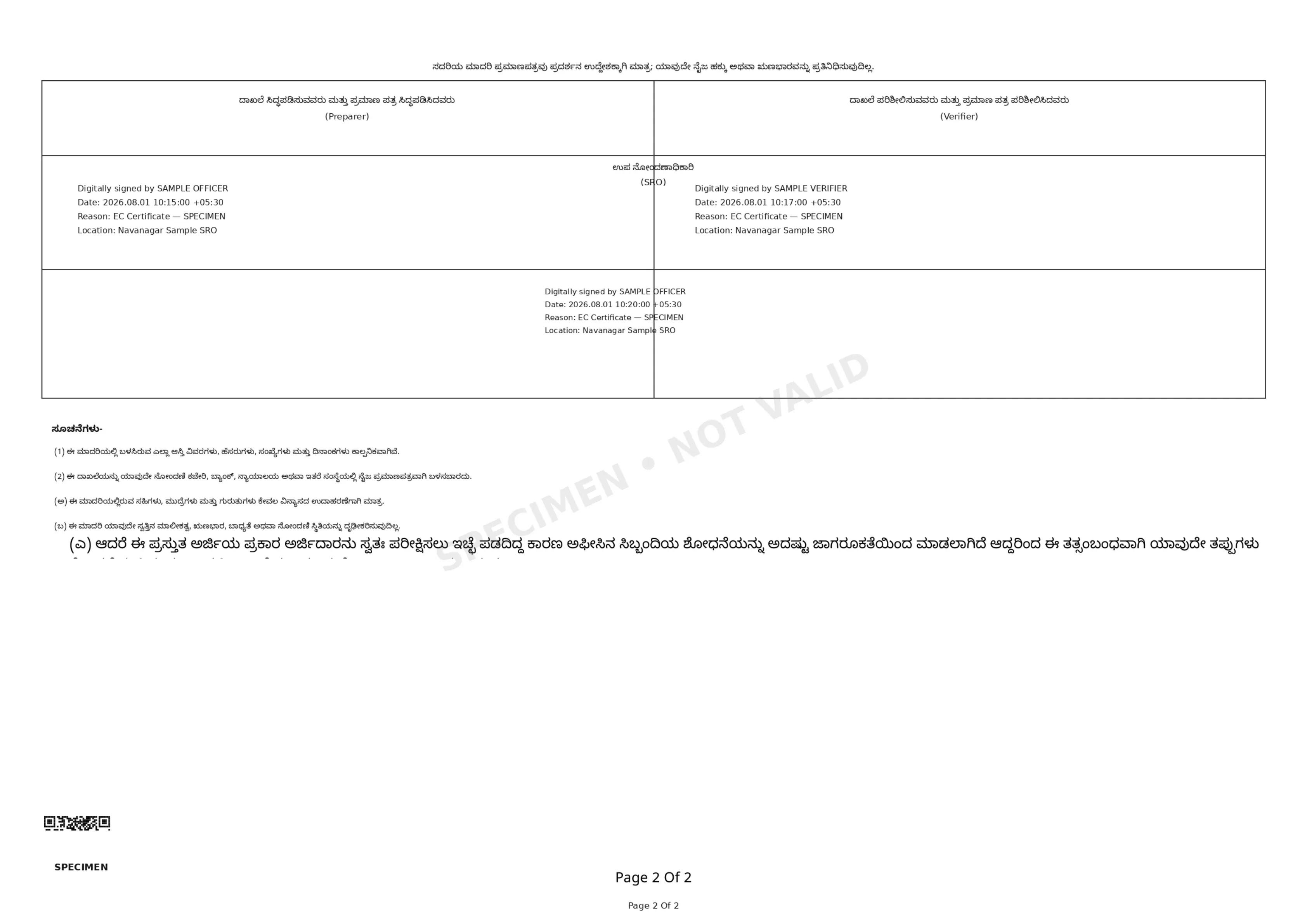
A specimen Form 15, cut into the parts worth understanding. Every crop is from the same fictional document, watermarked and issued by nobody.
Form 15, and the certificate reference

Scroll sideways to see the full width. Specimen document. Every name, number and measurement on it is fictional.
Form 15 is issued when registered transactions exist in the search period. It lists them. Form 16 is issued when none are found, and is commonly called a Nil EC.
The certificate number is what a bank or a lawyer will ask for when they want to verify the document independently.
The property, as you described it

Scroll sideways to see the full width. Specimen document. Every name, number and measurement on it is fictional.
Boundaries, survey and door numbers, area. This is the description the search was run against, and it came from the application, not from the register.
That distinction is the whole point of region 5 below.
The search period

Scroll sideways to see the full width. Specimen document. Every name, number and measurement on it is fictional.
Read the dates. This certificate covers 1 January 2010 to 1 July 2026 and says nothing whatsoever about anything before or after.
An EC period that starts suspiciously late, or stops short of today, is a red flag rather than an administrative detail.
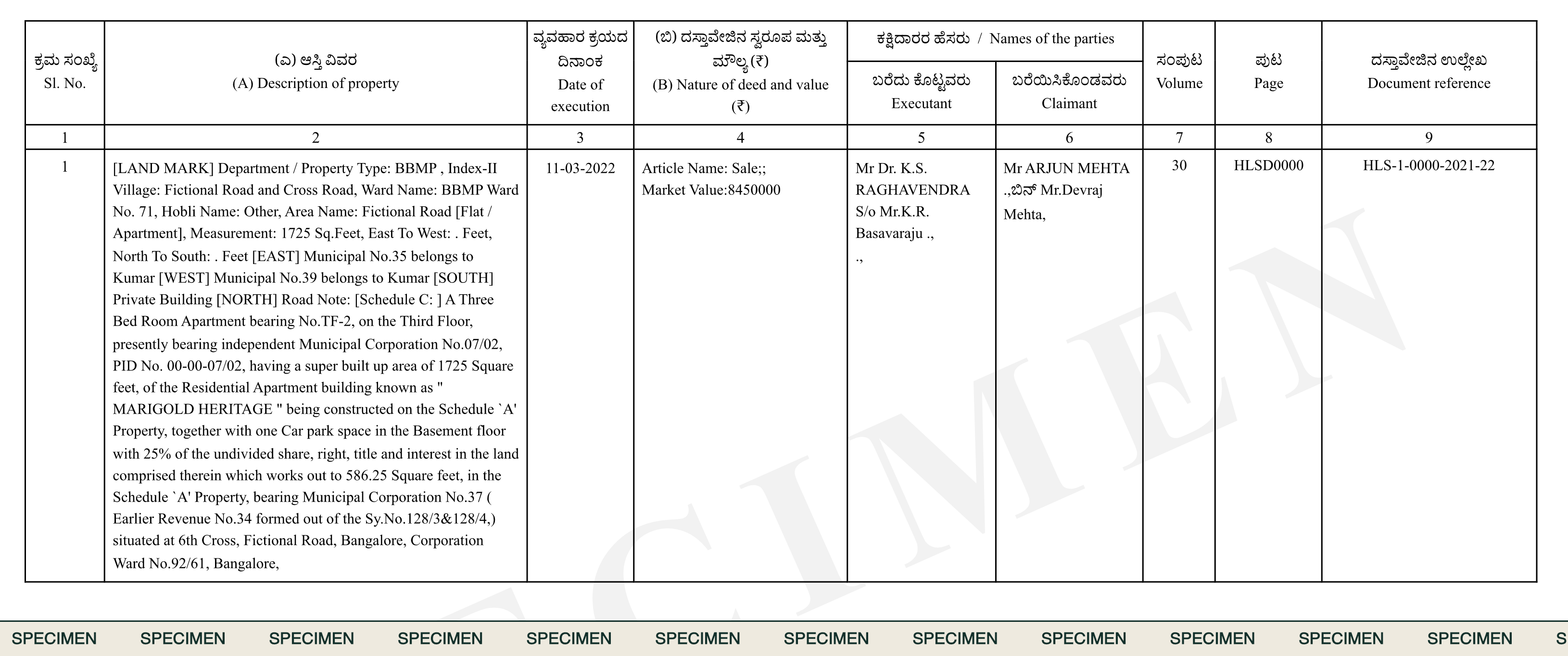
What a transaction entry looks like
Scroll sideways to see the full width. Specimen document. Every name, number and measurement on it is fictional.
Date of execution, nature of deed, market value, executant and claimant, volume, page and document reference.
The executant is the person transferring. The claimant is the person receiving. Follow those names down the entries and you are reading the chain of title, which is why the names on an EC have to match the deeds you have been shown.
The clause almost nobody reads

Scroll sideways to see the full width. Specimen document. Every name, number and measurement on it is fictional.
Printed in the notes at the foot of every Form 15:
"The description of the properties shown in this certificate is as furnished by the applicant. Where the description in the registered deeds differs from that furnished, such description cannot be included in this certificate."
Read that again. The search is only as good as the property description you gave it. Get a survey number, a door number or a boundary wrong on the application and you receive a clean, official, correctly issued certificate for a property that is not quite yours.
The same notes go on to say that where the applicant chose not to inspect the records personally, the department accepts no liability for anything the search missed.
This is not a trap the department is setting. It is stated plainly on the document. It is simply that almost nobody reads the notes page, and an EC is usually handed over as though it were a guarantee.
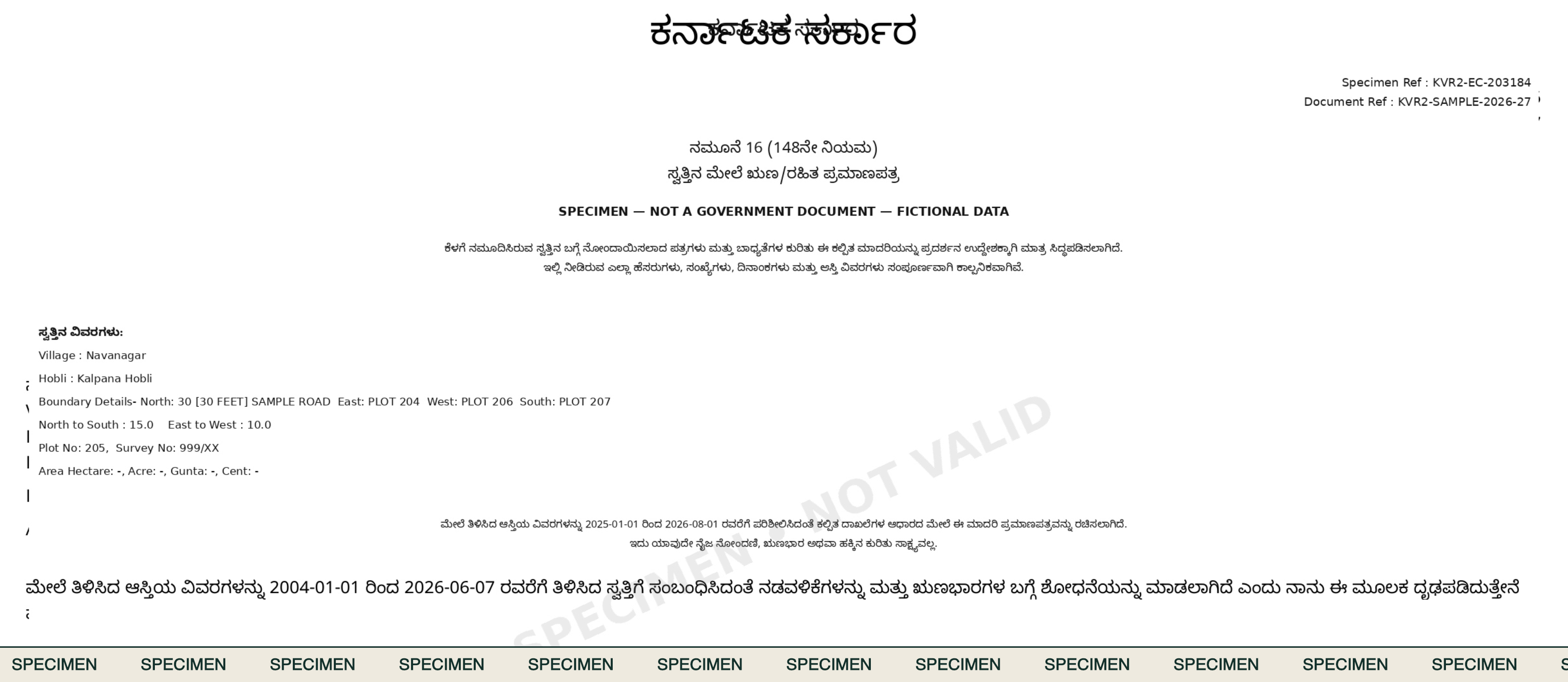
A Nil EC, read properly
The whole page is in the thumbnails at the top, where its shape is the point. This is the part of it that carries the meaning, at the same readable size as every crop above.
The property description and the nil statement
Scroll sideways to see the full width. Specimen document. Every name, number and measurement on it is fictional.
There is no transaction table, because there were no transactions to list. Everything region 5 above says about the property description applies here too, and with more force: a Form 16 issued against a description that does not match the registered deeds is a nil result for a property that is not quite yours.
What an EC does not show
This section is the reason to build this page.
- Unregistered agreements. Oral agreements, unregistered family settlements, powers of attorney that were never registered
- Pending litigation. A civil suit over the property will not appear
- Tenancy rights
- Anything before January 2003, since Form 15 records on Kaveri run from January 2003 to date
- Revenue records. RTC, mutation entries and Akarband are held by the revenue department, not on Kaveri. A clean EC tells you nothing about them
- Unauthorised construction or plan deviation
- Tax arrears
An EC is a necessary check. It is nowhere near a sufficient one, and a seller who offers one as though it settles everything is either uninformed or hoping you are.
How far back to go
What banks ask for: generally from the date the property was registered up to today. Some ask for the full history.
How far back you can actually get it online: the portal lets you apply back to January 2003. For the earlier part of that range you are issued a written copy which has to be collected in person from the sub-registrar, rather than a download.
Before that period, it is a physical application at the sub-registrar's office. There is no online route.
That is worth knowing before you promise a bank a 30 year EC on a two day turnaround.
How to get one
Kaveri Online at kaverionline.karnataka.gov.in. Register, choose the EC service, enter the property details and sub-registrar office, pay, and for digitised records it can generate immediately.
Get the sub-registrar office right. The EC searches one jurisdiction. Request it from the wrong office and you get a clean certificate that means nothing, because it searched the wrong register. The correct office is the one where the property's transactions were registered, and jurisdictions have been redrawn over the years, so a property near a boundary may have transactions sitting across two offices.
Cost. Approximately ₹5 application fee, ₹30 for the first year and ₹10 for each additional year, so a 15 year EC comes to roughly ₹170. Approximate and subject to change.
How long it takes: two to fifteen days. Sometimes it comes back almost immediately, sometimes it sits. Plan for the longer end when a registration date depends on it.
Red flags
- Form 16 offered as evidence of clear title
- EC period suspiciously short, or starting after a known transaction
- Mortgage entry with no corresponding release
- Names on the EC not matching the deed chain
- Property described differently on the EC than on the deed
Questions
- What is the difference between Form 15 and Form 16?
- Form 15 is issued when registered transactions exist in the search period, and it lists them. Form 16 is issued when none are found, and is commonly called a Nil EC.
- Does a Nil EC mean clear title?
- No. A Form 16 is often presented as proof of clean title. It means no registered transactions were found in the period searched, and nothing more. Unregistered agreements, pending litigation, tenancy rights and revenue records do not appear on it.
- How many years of EC do I need?
- Banks generally ask from the date the property was registered up to today, and some ask for the full history. The portal lets you apply back to January 2003. For the earlier part of that range you are issued a written copy which has to be collected in person from the sub-registrar. Before that period it is a physical application at the sub-registrar office, with no online route.
- Does an EC show court cases?
- No. Pending litigation does not appear. A civil suit over the property will not show up on an EC, and neither will unregistered agreements, tenancy rights, unauthorised construction or tax arrears.
- Why does the EC only go back to 2003?
- Form 15 records on Kaveri run from January 2003 to date. Anything before that is not on the online system and needs a physical application at the sub-registrar office.
- Can I get an EC online?
- Yes, from Kaveri Online at kaverionline.karnataka.gov.in. Register, choose the EC service, enter the property details and sub-registrar office, and pay. For digitised records it can generate immediately.
- What does an EC cost?
- Approximately ₹5 application fee, ₹30 for the first year and ₹10 for each additional year, so a 15 year EC comes to roughly ₹170. Approximate and subject to change.
- How long does an EC take?
- Two to fifteen days. Sometimes it comes back almost immediately, sometimes it sits. Plan for the longer end when a registration date depends on it.
Ask us about a specific EC.
Send us the certificate and we will tell you what it covers and what it leaves out.
General information, not advice. Compiled from public sources and professional input, and checked on the date shown at the top of this page. Indian property law, tax and municipal procedure change frequently. Confirm your own position with a Chartered Accountant, a lawyer or the relevant authority before you act. We are happy to introduce you to people we work with. Full disclaimer